
Research Blog
Insights, tutorials, and breakthroughs from our dedicated researchers. Stay updated with the latest in technology and science.
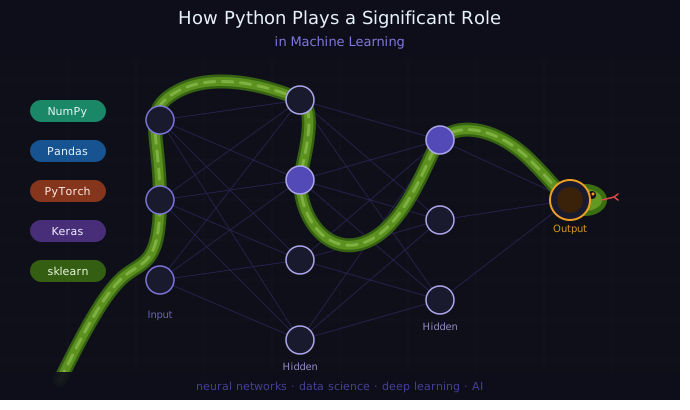
How Python Plays a Significant Role in Machine Learning
Machine learning is changing how we understand data, solve problems, and build intelligent systems. At the center of this transformation, Python has become one of the most important programming languages because it makes machine learning more accessible, practical, and research-friendly. Introduction Machine learning allows computers to learn patterns from data and make predictions or decisions without being directly programmed for every task. It is now widely used in healthcare, agriculture, environmental monitoring, water resources, finance, education, cybersecurity, and smart systems. However, machine learning does not work by theory alone. It needs tools that can process data, build models, evaluate results, and support real-world deployment. Python has become one of the most popular languages for machine learning because it is simple, flexible, and supported by a large number of powerful libraries. For students, researchers, and professionals, Python provides a smooth path from basic data analysis to advanced artificial intelligence. At WRESLab Bangladesh, where research focuses on water resources, environmental science, data analytics, and AI, Python is an essential tool for transforming raw data into meaningful insights. Why Python Is Popular in Machine Learning Python is popular because it is easy to read and write. Compared with many other programming languages, Python uses clear syntax that is close to natural language. This helps beginners focus more on the logic of machine learning instead of struggling with complex programming rules. Another reason is the strong Python ecosystem. Machine learning requires many steps, such as data collection, cleaning, visualization, model training, testing, and reporting. Python has libraries for each of these tasks. For example, NumPy supports numerical computation, Pandas supports data handling, Matplotlib supports visualization, and Scikit-learn supports machine learning models. Python also supports both simple and advanced research. A beginner can train a basic decision tree model using a few lines of code, while an advanced researcher can build deep learning models using TensorFlow or PyTorch. This flexibility makes Python suitable for undergraduate students, early-career researchers, and experienced academics. Python Makes Data Handling Easier Machine learning begins with data. Before training any model, researchers must collect, clean, organize, and understand the dataset. In real-world research, data is often incomplete, noisy, or unstructured. Python helps manage these challenges effectively. The Pandas library is one of the most useful tools for data handling. It allows researchers to read datasets, explore columns, check missing values, filter records, and prepare data for machine learning. This is especially important in research fields such as environmental data analysis, rainfall prediction, disease detection, and sensor-based monitoring. Example: loading and checking a dataset using Python: import pandas as pd # Load dataset data = pd.read_csv("research_data.csv") # Show first five rows print(data.head()) # Check dataset information print(data.info()) # Check missing values print(data.isnull().sum()) This simple code helps researchers quickly understand the structure and quality of their dataset. Without proper data checking, machine learning results may become unreliable. Python Supports Data Visualization Data visualization is important because it helps researchers understand patterns, trends, and relationships. A table full of numbers may be difficult to interpret, but a chart can make the message clearer. Python provides excellent visualization libraries such as Matplotlib, Seaborn, and Plotly. For example, a researcher working on water resource analysis may want to visualize monthly rainfall patterns. A healthcare researcher may want to compare disease cases across age groups. A machine learning researcher may want to show model accuracy using a line chart. Example: creating a simple graph in Python: import matplotlib.pyplot as plt months = ["Jan", "Feb", "Mar", "Apr", "May"] rainfall = [45, 60, 80, 120, 150] plt.plot(months, rainfall, marker="o") plt.title("Monthly Rainfall Trend") plt.xlabel("Month") plt.ylabel("Rainfall (mm)") plt.show() Visualization supports better decision-making. It also improves research communication by helping readers understand results more easily. Python Provides Powerful Machine Learning Libraries One of Python’s strongest contributions to machine learning is its rich collection of libraries. These libraries reduce the need to write every algorithm from scratch. Instead, researchers can focus on problem design, data quality, evaluation, and interpretation. Scikit-learn is widely used for traditional machine learning algorithms such as logistic regression, support vector machines, random forest, k-nearest neighbors, and decision trees. TensorFlow and PyTorch are used for deep learning tasks such as image classification, natural language processing, and medical diagnosis. Example: training a simple machine learning model using Scikit-learn: from sklearn.model_selection import train_test_split from sklearn.ensemble import RandomForestClassifier from sklearn.metrics import accuracy_score # Example features and labels X = data.drop("target", axis=1) y = data["target"] # Split data into training and testing sets X_train, X_test, y_train, y_test = train_test_split( X, y, test_size=0.2, random_state=42 ) # Create and train model model = RandomForestClassifier(random_state=42) model.fit(X_train, y_train) # Make predictions predictions = model.predict(X_test) # Evaluate accuracy accuracy = accuracy_score(y_test, predictions) print("Model Accuracy:", accuracy) This example shows how Python can train and evaluate a model with a clear and simple workflow. The same structure can be adapted for many research problems. Python Helps in Research Reproducibility Research should be reproducible. This means other researchers should be able to understand and repeat the experiment. Python supports reproducibility because code, data processing steps, model parameters, and evaluation methods can be clearly documented. Tools such as Jupyter Notebook and Google Colab make this process easier. Researchers can write explanations, equations, code, outputs, tables, and figures in one place. This is highly useful for academic research, project reports, and collaborative work. For students in Bangladesh and South Asia, this is important because reproducible research improves quality and builds trust. It also helps students prepare stronger theses, journal papers, and conference submissions. Python Connects Machine Learning with Real-World Applications Machine learning becomes valuable when it solves real problems. Python helps connect models with real-world systems. It can be used to build web applications, dashboards, APIs, automated reports, and data monitoring systems. For example, a Python-based machine learning system can help predict flood risk from rainfall and river-level data. It can classify medical images, detect abnormal network traffic, forecast crop disease, or analyze pollution levels. These applications directly connect with the research mission of WRESLab Bangladesh. Important real-world areas where Python supports machine learning include: Healthcare diagnosis and medical image analysis Water resource prediction and flood monitoring Environmental pollution and climate data analysis Smart agriculture and crop disease detection Cybersecurity and anomaly detection Python is not only a programming language; it is a complete research environment for developing intelligent solutions. Python Supports Deep Learning and Artificial Intelligence Modern machine learning includes deep learning, where neural networks learn complex patterns from large datasets. Python is the main language for many deep learning frameworks, including TensorFlow, Keras, and PyTorch. Deep learning is widely used in image classification, speech recognition, medical diagnosis, natural language processing, and autonomous systems. With Python, researchers can design neural networks, train models using GPUs, and evaluate performance using advanced metrics. Example: a simple neural network structure using Keras: from tensorflow.keras.models import Sequential from tensorflow.keras.layers import Dense model = Sequential() model.add(Dense(64, activation="relu", input_shape=(10,))) model.add(Dense(32, activation="relu")) model.add(Dense(1, activation="sigmoid")) model.compile( optimizer="adam", loss="binary_crossentropy", metrics=["accuracy"] ) model.summary() This code defines a basic neural network for binary classification. Although simple, it shows how Python makes deep learning model design understandable and accessible. Python Encourages Learning and Collaboration Python has a large global community. Students can find tutorials, documentation, open-source projects, and research code online. This makes learning easier and encourages collaboration. In academic research, collaboration is essential. Python allows researchers from different backgrounds to work together using shared notebooks, GitHub repositories, and cloud-based platforms. A student working on environmental science can collaborate with a data scientist, while a healthcare researcher can work with an AI expert. At WRESLab Bangladesh, this collaborative spirit is important. The lab encourages students to learn practical tools, build research confidence, and apply data-driven methods to meaningful problems. Challenges of Using Python in Machine Learning Although Python is powerful, researchers must use it carefully. A good machine learning project requires more than running code. Students must understand the data, choose proper methods, avoid data leakage, evaluate fairly, and explain the results. Common mistakes include using poor-quality data, training models without proper validation, reporting only accuracy, and making exaggerated claims. Python can make model building easy, but responsible research requires critical thinking and scientific discipline. Therefore, students should learn both coding and research methodology. The goal is not only to build a model but also to produce reliable, ethical, and useful knowledge. Conclusion Python plays a significant role in machine learning because it makes data processing, visualization, model development, evaluation, and deployment easier. Its simple syntax, powerful libraries, strong community, and research-friendly tools have made it one of the most important languages in modern AI. For undergraduate students and early-career researchers, Python is an excellent starting point for entering the world of machine learning. For academic laboratories, it provides a practical foundation for solving real-world problems in healthcare, water resources, environmental science, and data analytics. WRESLab Bangladesh believes that Python-based machine learning can help young researchers convert data into useful knowledge and build solutions for society. By learning Python with strong research ethics and clear methodology, students can contribute to meaningful innovation in Bangladesh, South Asia, and beyond. Transforming data into insights, one algorithm at a time

From Idea to Publication: A Beginner’s Guide for Student Researchers
Every publication begins with a simple idea. The difference between an idea and a published paper is a structured research process, consistent effort, careful writing, and respect for academic standards. Start with a Clear Research Problem A good research paper begins with a clear problem. Students often start with a broad interest such as artificial intelligence, water resources, healthcare, or environmental science. The next step is to narrow that interest into a specific question. For example, instead of saying “I want to work on AI,” a student may ask, “How can machine learning improve flood risk prediction using rainfall and river data?” This type of focused question helps guide the entire research process. Read the Literature Carefully Before designing a study, researchers must understand what has already been done. Literature review helps students identify methods, datasets, limitations, and research gaps. It also prevents duplication and improves the quality of the proposed work. Students should not only collect papers but also read them critically. They should ask what problem each paper solves, what method it uses, what results it reports, and what limitations remain. Useful literature review practices include: Reading recent journal and conference papers Preparing short summaries of each paper Grouping papers by method or topic Identifying gaps and unresolved problems Maintaining proper citation records Design the Method and Collect Data After identifying the research gap, the next step is to design the method. This may include selecting a dataset, developing a model, preparing experiments, or defining evaluation metrics. A strong method should be logical, reproducible, and connected to the research problem. For data-driven research, data quality is extremely important. Poor data can lead to weak conclusions. Students should document how data were collected, cleaned, processed, and analyzed. Analyze Results and Be Honest Results should be evaluated carefully. A researcher should not only report high accuracy or strong performance but also explain what the results mean. Comparing with baseline methods, showing limitations, and discussing possible errors are important parts of academic honesty. WRESLab Bangladesh encourages young researchers to avoid exaggerated claims. A good paper is not only one that reports strong results; it is one that presents evidence clearly and responsibly. Write, Revise, and Prepare for Submission Writing is a major part of research. A paper usually includes an introduction, literature review, methodology, results, discussion, conclusion, and references. Each section has a specific purpose and should be written with clarity. Revision is also essential. Most strong papers are improved through multiple rounds of editing. Students should check structure, grammar, figures, tables, citations, and formatting before submission. Conclusion The journey from idea to publication requires discipline, patience, and guidance. Student researchers should begin with a focused problem, study the literature, design a clear method, analyze results honestly, and revise carefully. WRESLab Bangladesh is committed to supporting young researchers in this journey by promoting ethical, data-driven, and impactful research.
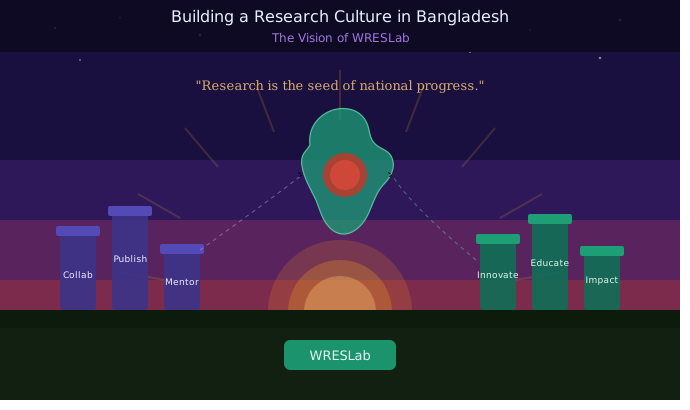
Building a Research Culture in Bangladesh: The Vision of WRESLab
A strong research culture does not grow overnight. It develops through mentorship, discipline, collaboration, ethical practice, and the belief that local researchers can solve both local and global problems. Why Research Culture Matters Research culture refers to the values, habits, and systems that support meaningful academic work. It includes curiosity, honesty, teamwork, critical thinking, and respect for evidence. Without a strong research culture, students may see research only as a requirement instead of a path to innovation. In Bangladesh, many students are talented and motivated, but they often need structured guidance. WRESLab Bangladesh aims to support this need by creating a research environment where young scholars can learn, practice, and grow with confidence. Connecting Local Problems with Global Knowledge Bangladesh faces important challenges related to water resources, climate change, environmental management, public health, agriculture, and digital transformation. These challenges require research that is locally grounded and globally informed. WRESLab Bangladesh encourages students and academics to study international methods while applying them to regional problems. This approach helps researchers produce work that is both scientifically strong and socially relevant. Mentorship as a Core Foundation Mentorship is one of the most important parts of research culture. Many students have interest in research but do not know how to start. A mentor can help them select a topic, read literature, design a study, analyze data, and prepare a manuscript. Effective mentorship includes: Guiding students from basic concepts to advanced methods Teaching responsible research and academic integrity Encouraging regular writing and presentation practice Supporting teamwork and peer learning Helping students understand publication standards Building Confidence Among Young Researchers Many undergraduate students hesitate to begin research because they think it is too difficult. However, research becomes manageable when it is learned step by step. Small tasks such as reading one paper, preparing a summary, or analyzing a small dataset can build confidence. WRESLab Bangladesh promotes a progressive learning model. Students begin with foundational skills and gradually move toward independent research, publication preparation, and collaborative projects. Collaboration Beyond Borders Modern research is international. Collaboration allows researchers to share expertise, compare methods, and improve the quality of their work. For Bangladeshi students and academics, international collaboration can open doors to higher studies, joint publications, and global research networks. WRESLab Bangladesh aims to serve as a bridge between local talent and international research opportunities. Its vision is to create a platform where knowledge, mentorship, and innovation can move across borders. Conclusion Building a research culture in Bangladesh requires patience, leadership, and long-term commitment. WRESLab Bangladesh, founded by Wahid/Wahidur Rahman, seeks to inspire young researchers to think critically, work ethically, and contribute to real-world solutions. Through data analytics, AI, environmental science, and collaborative research, the lab works toward a stronger academic future for Bangladesh and South Asia.
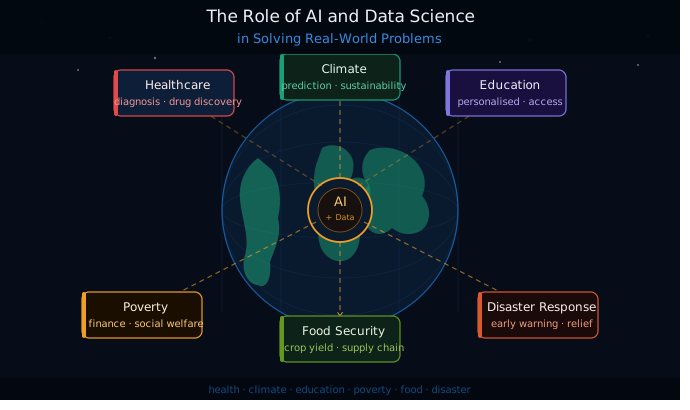
The Role of AI and Data Science in Solving Real-World Problems
Artificial intelligence and data science are no longer limited to laboratories or advanced technology companies. They are becoming practical tools for understanding complex problems and designing smarter solutions for society. Data as a Foundation for Better Decisions Every real-world problem produces data. Water levels, rainfall patterns, air quality, disease trends, student performance, crop conditions, and energy use all create measurable information. Data science helps convert this information into patterns, explanations, and predictions. For countries like Bangladesh, where environmental, social, and infrastructure challenges are closely connected, data-driven decision-making is essential. WRESLab Bangladesh focuses on transforming raw data into useful insights that can support research, planning, and innovation. Artificial Intelligence as a Problem-Solving Tool AI allows computers to learn from data and improve performance over time. It can classify images, predict risks, detect anomalies, recommend actions, and automate complex tasks. When used responsibly, AI can support researchers, policymakers, engineers, and healthcare professionals. For example, AI can help predict flood-prone areas, detect diseases from medical images, classify waste materials, monitor environmental changes, and identify cybersecurity threats. These applications show how AI can contribute to both scientific progress and public welfare. Practical Areas Where AI and Data Science Matter AI and data science can support many real-world domains, including: Water resources and flood prediction Environmental monitoring and pollution analysis Healthcare diagnosis and patient risk prediction Agriculture and crop disease detection Smart cities, transport, and waste management These areas are highly relevant for Bangladesh and South Asia. Local researchers can make important contributions by developing solutions that reflect regional data, climate, infrastructure, and community needs. The Need for Ethical and Responsible Use AI is powerful, but it must be used carefully. Poor data quality, biased datasets, unclear methods, and lack of transparency can produce unreliable results. Responsible AI requires clear documentation, fair evaluation, privacy protection, and honest reporting of limitations. WRESLab Bangladesh encourages researchers to combine technical skill with ethical awareness. A good AI model should not only perform well; it should also be understandable, reliable, and useful in real-world settings. Building Skills for the Future Students and early-career researchers should begin by learning the fundamentals of data handling, statistics, programming, and domain knowledge. Strong AI research requires both technical expertise and an understanding of the problem being solved. Researchers should also learn how to communicate results clearly. A model is only useful when its findings can be understood and applied by others. Conclusion AI and data science are reshaping how we understand and solve real-world problems. They provide tools for better prediction, smarter planning, and evidence-based decision-making. Through research, training, and collaboration, WRESLab Bangladesh aims to prepare young researchers to use these tools for meaningful impact.

How Federated Learning Is Transforming Healthcare AI
Healthcare data is highly valuable, but it is also highly sensitive. Federated learning offers a new direction where artificial intelligence can learn from distributed medical data without requiring hospitals or institutions to share raw patient records. The Privacy Challenge in Healthcare AI Artificial intelligence has shown strong potential in medical image analysis, disease prediction, patient monitoring, and clinical decision support. However, healthcare AI depends heavily on data. The challenge is that medical data contains sensitive personal information and cannot be freely shared across hospitals, clinics, or research centers. This creates a major barrier for AI development, especially in regions where large medical datasets are limited. Federated learning addresses this challenge by allowing models to learn from data stored at different locations while keeping the original data local. What Makes Federated Learning Different In traditional machine learning, data from many sources is usually collected in one central server. In federated learning, the model is sent to each participating institution. Each institution trains the model locally and shares only model updates, not raw data. This approach supports privacy-aware collaboration. Hospitals, laboratories, and research groups can contribute to a shared AI model without directly exchanging patient-level information. For healthcare systems in Bangladesh and South Asia, this can open new opportunities for collaborative medical AI research. Benefits for Medical Imaging and Diagnosis Federated learning is especially useful in medical imaging, where data such as X-rays, MRI scans, CT images, and wound images may be difficult to share because of privacy rules and institutional restrictions. A federated model can learn from diverse medical images across multiple sites and become more generalizable. Key benefits include the following: Better privacy protection for patient data Collaboration across hospitals and research centers Reduced need for central data pooling Improved model learning from diverse populations Support for responsible and ethical healthcare AI Challenges That Still Need Attention Although federated learning is promising, it is not a complete solution by itself. Model updates may still leak information if proper privacy protections are not used. Techniques such as differential privacy, secure aggregation, encrypted communication, and careful threat modeling are important. There are also practical challenges. Different hospitals may use different devices, data formats, and labeling systems. Internet connectivity, computing resources, and technical expertise may vary. These issues must be addressed before federated healthcare AI can be widely deployed. WRESLab Bangladesh and Responsible Healthcare AI WRESLab Bangladesh recognizes federated learning as an important research direction for privacy-preserving healthcare innovation. By combining data analytics, AI, and responsible research practices, the lab aims to support solutions that respect patient privacy while improving diagnostic intelligence. Conclusion Federated learning is transforming healthcare AI by enabling collaboration without direct data sharing. It can help build stronger, more inclusive, and more privacy-aware medical AI systems. For Bangladesh and South Asia, this approach offers a pathway toward ethical innovation in digital health, aligned with the mission of WRESLab Bangladesh.
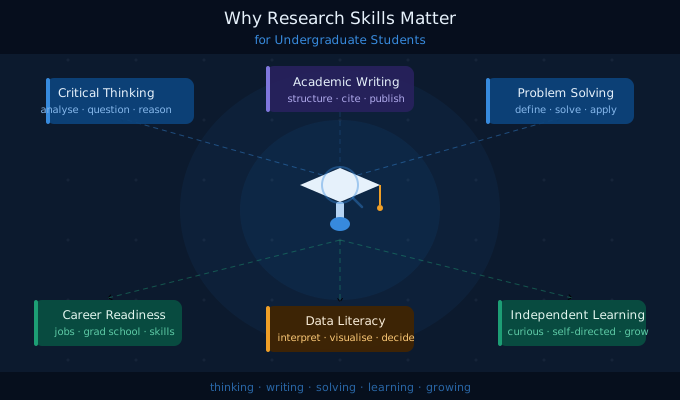
Why Research Skills Matter for Undergraduate Students
"Research is not only for senior scholars or postgraduate students. For undergraduate students, research skills build the foundation for critical thinking, problem-solving, innovation, and lifelong academic growth." Research Builds Independent Thinking Undergraduate education often focuses on learning established theories, methods, and facts. However, research teaches students how to move beyond memorization and ask deeper questions. It encourages them to examine evidence, compare ideas, and identify gaps in existing knowledge. For students in Bangladesh and South Asia, this skill is especially important. Many local challenges in water resources, public health, agriculture, environment, and technology require context-specific solutions. WRESLab Bangladesh believes that undergraduate students can contribute meaningfully when they are trained to think independently and systematically. Research Skills Improve Academic and Career Readiness Research experience helps students prepare for higher studies, scholarships, and professional careers. A student who understands how to read papers, design experiments, analyze data, and write reports becomes more confident in academic and professional environments. These skills are also useful beyond academia. Employers increasingly value graduates who can solve complex problems, work with data, communicate findings, and adapt to new technologies. Research training supports all these abilities. Practical research skills undergraduate students should develop include: Reading and summarizing academic papers Identifying clear research problems Learning basic data analysis tools Writing structured reports and manuscripts Presenting findings with clarity and confidence Research Encourages Innovation Innovation begins with curiosity. When students ask why a problem exists and how it can be solved, they begin the research process. This mindset can lead to new tools, improved methods, and practical solutions for society. At WRESLab Bangladesh, research is connected with real-world problems in water resources, environmental science, data analytics, and artificial intelligence. Students are encouraged to see research not only as an academic requirement but also as a way to create meaningful impact. Research Develops Communication and Collaboration A strong researcher must communicate clearly. Undergraduate research helps students learn how to explain complex ideas in simple and professional language. It also teaches teamwork, because most research projects require collaboration among students, mentors, and institutions. For early-career researchers, this experience is valuable. It builds confidence and prepares them for conferences, journal submissions, project proposals, and international collaborations. Conclusion Research skills matter because they transform students from passive learners into active problem-solvers. For Bangladesh and South Asia, developing research capacity at the undergraduate level is essential for building a stronger academic and innovation ecosystem. WRESLab Bangladesh is committed to guiding young researchers toward meaningful, ethical, and data-driven research.