
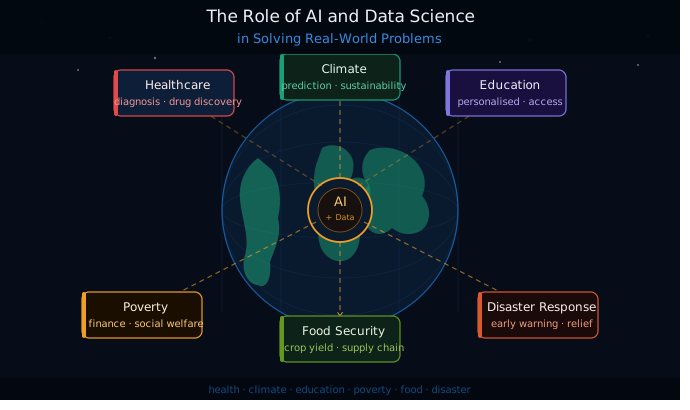
Artificial intelligence and data science are no longer limited to laboratories or advanced technology companies. They are becoming practical tools for understanding complex problems and designing smarter solutions for society.
Data as a Foundation for Better Decisions
Every real-world problem produces data. Water levels, rainfall patterns, air quality, disease trends, student performance, crop conditions, and energy use all create measurable information. Data science helps convert this information into patterns, explanations, and predictions.
For countries like Bangladesh, where environmental, social, and infrastructure challenges are closely connected, data-driven decision-making is essential. WRESLab Bangladesh focuses on transforming raw data into useful insights that can support research, planning, and innovation.
Artificial Intelligence as a Problem-Solving Tool
AI allows computers to learn from data and improve performance over time. It can classify images, predict risks, detect anomalies, recommend actions, and automate complex tasks. When used responsibly, AI can support researchers, policymakers, engineers, and healthcare professionals.
For example, AI can help predict flood-prone areas, detect diseases from medical images, classify waste materials, monitor environmental changes, and identify cybersecurity threats. These applications show how AI can contribute to both scientific progress and public welfare.
Practical Areas Where AI and Data Science Matter
AI and data science can support many real-world domains, including:
- Water resources and flood prediction
- Environmental monitoring and pollution analysis
- Healthcare diagnosis and patient risk prediction
- Agriculture and crop disease detection
- Smart cities, transport, and waste management
These areas are highly relevant for Bangladesh and South Asia. Local researchers can make important contributions by developing solutions that reflect regional data, climate, infrastructure, and community needs.
The Need for Ethical and Responsible Use
AI is powerful, but it must be used carefully. Poor data quality, biased datasets, unclear methods, and lack of transparency can produce unreliable results. Responsible AI requires clear documentation, fair evaluation, privacy protection, and honest reporting of limitations.
WRESLab Bangladesh encourages researchers to combine technical skill with ethical awareness. A good AI model should not only perform well; it should also be understandable, reliable, and useful in real-world settings.
Building Skills for the Future
Students and early-career researchers should begin by learning the fundamentals of data handling, statistics, programming, and domain knowledge. Strong AI research requires both technical expertise and an understanding of the problem being solved.
Researchers should also learn how to communicate results clearly. A model is only useful when its findings can be understood and applied by others.
Conclusion
AI and data science are reshaping how we understand and solve real-world problems. They provide tools for better prediction, smarter planning, and evidence-based decision-making. Through research, training, and collaboration, WRESLab Bangladesh aims to prepare young researchers to use these tools for meaningful impact.