
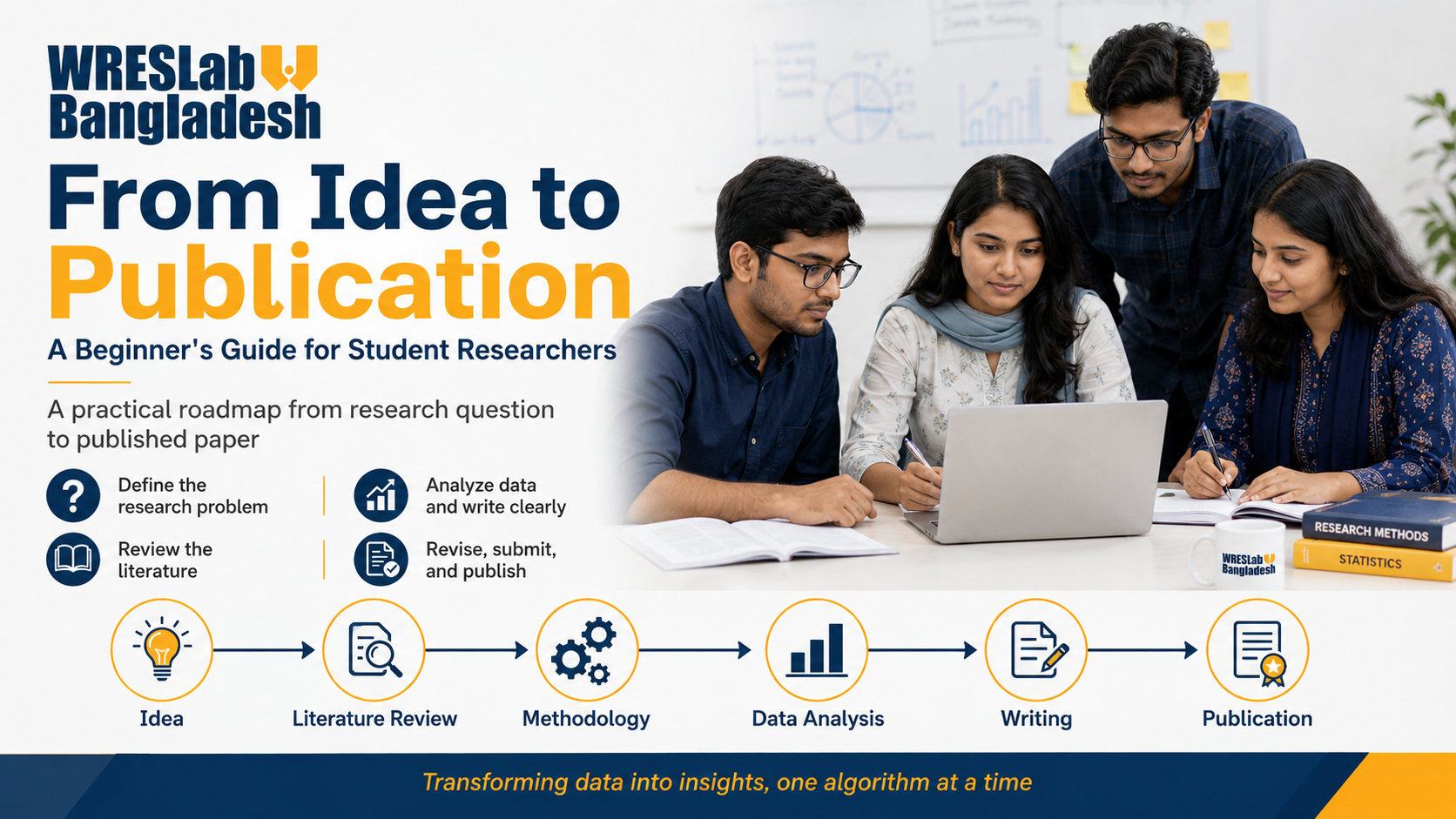
Every publication begins with a simple idea. The difference between an idea and a published paper is a structured research process, consistent effort, careful writing, and respect for academic standards.
Start with a Clear Research Problem
A good research paper begins with a clear problem. Students often start with a broad interest such as artificial intelligence, water resources, healthcare, or environmental science. The next step is to narrow that interest into a specific question.
For example, instead of saying “I want to work on AI,” a student may ask, “How can machine learning improve flood risk prediction using rainfall and river data?” This type of focused question helps guide the entire research process.
Read the Literature Carefully
Before designing a study, researchers must understand what has already been done. Literature review helps students identify methods, datasets, limitations, and research gaps. It also prevents duplication and improves the quality of the proposed work.
Students should not only collect papers but also read them critically. They should ask what problem each paper solves, what method it uses, what results it reports, and what limitations remain.
Useful literature review practices include:
· Reading recent journal and conference papers
· Preparing short summaries of each paper
· Grouping papers by method or topic
· Identifying gaps and unresolved problems
· Maintaining proper citation records
Design the Method and Collect Data
After identifying the research gap, the next step is to design the method. This may include selecting a dataset, developing a model, preparing experiments, or defining evaluation metrics. A strong method should be logical, reproducible, and connected to the research problem.
For data-driven research, data quality is extremely important. Poor data can lead to weak conclusions. Students should document how data were collected, cleaned, processed, and analyzed.
Analyze Results and Be Honest
Results should be evaluated carefully. A researcher should not only report high accuracy or strong performance but also explain what the results mean. Comparing with baseline methods, showing limitations, and discussing possible errors are important parts of academic honesty.
WRESLab Bangladesh encourages young researchers to avoid exaggerated claims. A good paper is not only one that reports strong results; it is one that presents evidence clearly and responsibly.
Write, Revise, and Prepare for Submission
Writing is a major part of research. A paper usually includes an introduction, literature review, methodology, results, discussion, conclusion, and references. Each section has a specific purpose and should be written with clarity.
Revision is also essential. Most strong papers are improved through multiple rounds of editing. Students should check structure, grammar, figures, tables, citations, and formatting before submission.
Conclusion
The journey from idea to publication requires discipline, patience, and guidance. Student researchers should begin with a focused problem, study the literature, design a clear method, analyze results honestly, and revise carefully. WRESLab Bangladesh is committed to supporting young researchers in this journey by promoting ethical, data-driven, and impactful research.