
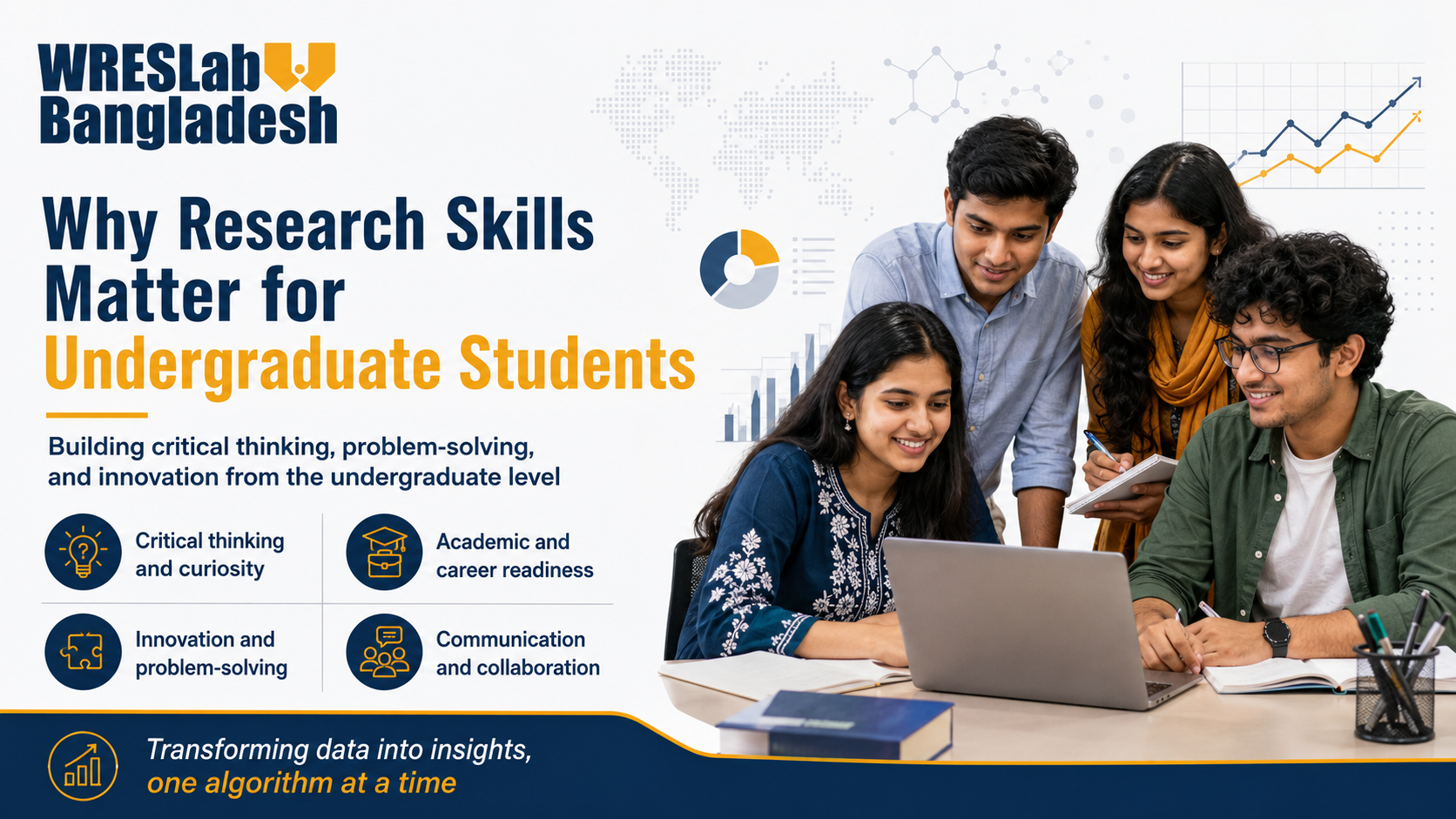
"Research is not only for senior scholars or postgraduate students. For undergraduate students, research skills build the foundation for critical thinking, problem-solving, innovation, and lifelong academic growth."
Research Builds Independent Thinking
Undergraduate education often focuses on learning established theories, methods, and facts. However, research teaches students how to move beyond memorization and ask deeper questions. It encourages them to examine evidence, compare ideas, and identify gaps in existing knowledge.
For students in Bangladesh and South Asia, this skill is especially important. Many local challenges in water resources, public health, agriculture, environment, and technology require context-specific solutions. WRESLab Bangladesh believes that undergraduate students can contribute meaningfully when they are trained to think independently and systematically.
Research Skills Improve Academic and Career Readiness
Research experience helps students prepare for higher studies, scholarships, and professional careers. A student who understands how to read papers, design experiments, analyze data, and write reports becomes more confident in academic and professional environments.
These skills are also useful beyond academia. Employers increasingly value graduates who can solve complex problems, work with data, communicate findings, and adapt to new technologies. Research training supports all these abilities.
Practical research skills undergraduate students should develop include:
Reading and summarizing academic papers
Identifying clear research problems
Learning basic data analysis tools
Writing structured reports and manuscripts
Presenting findings with clarity and confidence
Research Encourages Innovation
Innovation begins with curiosity. When students ask why a problem exists and how it can be solved, they begin the research process. This mindset can lead to new tools, improved methods, and practical solutions for society.
At WRESLab Bangladesh, research is connected with real-world problems in water resources, environmental science, data analytics, and artificial intelligence. Students are encouraged to see research not only as an academic requirement but also as a way to create meaningful impact.
Research Develops Communication and Collaboration
A strong researcher must communicate clearly. Undergraduate research helps students learn how to explain complex ideas in simple and professional language. It also teaches teamwork, because most research projects require collaboration among students, mentors, and institutions.
For early-career researchers, this experience is valuable. It builds confidence and prepares them for conferences, journal submissions, project proposals, and international collaborations.
Conclusion
Research skills matter because they transform students from passive learners into active problem-solvers. For Bangladesh and South Asia, developing research capacity at the undergraduate level is essential for building a stronger academic and innovation ecosystem. WRESLab Bangladesh is committed to guiding young researchers toward meaningful, ethical, and data-driven research.